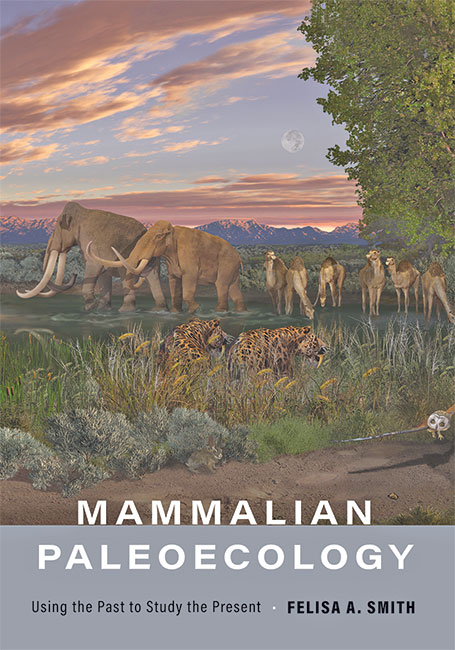
Felisa A. Smith  Associate Professor
 

Curriculum Vitae

Research Interests

Ecological and evolutionary effects of past and present climate change on mammals; variant and invariant patterns of body size across spatial, temporal and taxonomic scales; historical role of women in science

Education

  • 1986 to 1992. Department of Ecology and Evolutionary Biology, University of California at Irvine, Dr. Richard E. Lenski, Advisor; Ph.D. awarded December 1991
  • 1981 to 1982. Graduate Program in Education, University of California at Irvine; Clear teaching credential in physical and life sciences awarded 1982
  • 1976 to 1980.B. A. in Biology, Double Minor in Literature and Visual Arts; Revelle College, University of California at San Diego

Professional Experience

  • 2006 to present. Associate Professor, Department of Biology, University of New Mexico.
  • 2006 to present. Co-Director, Program in Interdisciplinary Biological & Biomedical Science, University of New Mexico.
  • 2004 to 2006. Research Professor, Department of Biology, University of New Mexico.
  • 1999 to 2004.  Research Associate Professor, Department of Biology, University of New Mexico.
  • 2003 to 2005.  Vice President for Development and Awards, International Biogeography Society.
  • 2002 to present.  American Society of Mammalogists Ombudsperson.
  • 1999 to present.  Elected Member, Board of Directors, American Society of Mammalogists (re-elected 1999-2002, 2002-2004, 2004-2006).
  • 1998 to 1999.  Research Assistant Professor, Department of Biology, University of New Mexico.
  • 1993 to 1996.  National Science Foundation BBS Minority Postdoctoral Research Fellow, Department of Biology, University of New Mexico, James H. Brown, sponsor.
  • 1981 to 1986.  High School Science Teacher; JV and Varsity Softball Coach, Katella and Laguna Hills High Schools, California.

Publications

Technical Reports

(3 representative samples of 7)

  • Smith, F.A.  1992.  Species accounts for selected vertebrate fauna at the Lake Mathews study area, Riverside County, California.  Prepared for the Metropolitan Water District of Southern California (via Impact Sciences, Inc.), 120 pages.

  • Monroe, J., W.D. Wagner, J. Carr and F.A. Smith.  1992.  Multi-species habitat conservation plan for Southwestern Riverside County, California.  Riverside County Habitat Conservation Agency and Metropolitan Water District of Southern California, 275 pages.  Received a Presidental Award for Excellence.

  • Elliott, S., D.R. Blake, J.C. Coman, M.K. Dubey, F.S. Rowland, T. Shirai, and F.A. Smith.  2000.  Multivariate analysis of whole air hydrocarbon data:  a principal components factor reduction applied to BIBLE B aircraft samples.  Los Alamos National Laboratory Technical Report in the LAUR series.

Professional Activities

Invited Seminars

  • Body size variation in woodrats (Neotoma), Colorado State University at Fort Collins (1992)

  • The relationship between nutritional ecology and body size, Tumamoc Hill Desert Research Laboratory (1992)

  • Evolutionary influences on body size:  why aren’t rats the size of cats? Museum of Vertebrate Zoology Colloquium in Evolutionary Biology, University of California Berkeley (1996)

  • Microevolutionary response of woodrats to climate change over the last 20,000 years, University of California Berkeley (1996)

  • Microevolutionary response of woodrats to climate change since the last glacial maximum, University of Colorado Boulder (1996)

  • Response of small mammals to late Quaternary climate change, University of Connecticut (1996)

  • Mammals and climate change:  revelations of the paleoecological record, Stanford University (1997)

  • Spatial and temporal variation in evolutionary responses to temperature fluctuations, Santa Fe Institute (1997)

  • The response of mammalian body size to past, present, and future climatic change, University of California Davis (1998)

  • Late Quaternary climate change and its influence on mammalian evolution, Washington State University (1998)

  • Evolutionary response of woodrats to climate change over the past 20,000 years, Colorado State University at Fort Collins (1998)

  • Warme macht Zwerge: the influence of temperature on mammalian evolution, Keynote address at symposium on “Women in Science” University of Alaska Fairbanks (1999)

  • How have mammals responded to climate change over the past 20,000 years?  Case studies from the rodent genus Neotoma, Amherst College (2001)

  • Woodrats as paleothermometers:  body size and environmental temperature in the past, present and future, University of Minnesota (2001).

  • Body size, space and time:  insights from a macroecological perspective.  Symposium on "Macroecology of Mammals: Patterns, Processes, and Possibilities", American Society of Mammalogists Annual Meeting (June 2002).

  • Quantifying the obvious?  Phylogenetic variation in body mass across diverse taxa. Symposium on “Body size in ecology and paleoecology – linking pattern and process”, Ecological Society of America. Co-organizer and Participant. (August 2002).

  • Biogeographic responses of mammals to climate change.  Symposium on “Biogeographic responses to climate change”, International Society of Biogeography.  Organizer and Participant (January 2005).

  • The past as key to the future: predicting mammalian responses to anthropogenic climate change. Symposium on “Ecotypic Variation in the Context of Global Climate Change: Revisiting the "Rules”, Jointly sponsored conference of the Society for the Study of Evolution, the Society of Systematic Biologists, and the American Society of Naturalists (June 2005).

  • The NSF review process from the perspective of a panelist/reviewer.   Plenary Talk.  Quality Education of Minorities Network Workshop, National Science Foundation Directorate for Biological Science, Albuquerque, New Mexico (March 2006).

  • On being the right size – the influence of temperature on mammalian evolution.  Evolutionary Morphology Seminar Series, Committee on Evolutionary Biology, University of Chicago (May 2006).

  • The influence of late Quaternary climate change on mammalian evolution. International conference on Macroecological tools for global change research.  Potsdam Institute for Climate Impact Research, Potsdam Germany (August 2006).

  • Life in an extreme environment:  the evolutionary history of Neotoma in Death Valley, CA. Symposium on Biotic response to global environmental change:  analogs for the future of live on Earth, Paleontological Society, Philadelphia (October 2006).

  • A tale of two species:  extirpation, range expansion & evolution in an extreme environment during the late Quaternary.  Organized oral session on “Stepping back in time: The application of historical & fossil records to recovering ecological baselines”, Ecological Society of America, San Jose, California (August 2007).  Co-chaired with Rebecca Terry.

  • Integrating pattern and process across macroecological scales:  a report from year 1.  Research Coordination Directors Meeting, National Science Foundation, Washington, D.C. (September 2007).

  • A tale of two species:  extirpation, range expansion & evolution in an extreme environment during the late Quaternary. Museum of Vertebrate Zoology Colloquium in Evolutionary Biology, University of California Berkeley, Berkeley, California (November 2007).

Invited Workshops and Working Groups

  • National Science Foundation/National Center Ecological Analysis and Synthesis workshop on Scaling in Biology: from organisms to ecosystems (J.H. Brown and G. West, organizers), Santa Fe Institute, October 1997.  Participant.

  • Ecological Society of America and Geological Society of America Penrose Conference on Linking spatial and temporal scales in paleoecology and ecology (A.S. Cohen , J.H. Brown, D. Springer, and P. Holterhoff, organizers), Chesapeake Bay, May 1998.  Participant and Panel Member.

  • National Center Ecological Analysis and Synthesis Working Group on Habitat and climate inference from the structure of mammalian communities (J. Damuth, group leader), 1998-2001. Member.

  • National Center Ecological Analysis and Synthesis Working Group on Body Size in Paleobiology and Ecology:  linking pattern and process across spatial, temporal and taxonomic scales (1999-2001).  Group leader and organizer.

  • National Science Foundation/Santa Fe Institute workshop on Hierarchies and Scales (C. Allen and C.S. Holling, organizers), Santa Fe Institute, May 2001.  Participant.

  • Gordon Research Conference on the Metabolic Basis of Ecology (J.H. Brown and J.F. Gillooly, chairs), Bates College, Maine, July 2004.  Discussion Leader.

  • Ecological History and Conservation Workshop (J. Dolan, H.W. Greene, and P.S. Martin, organizers).  Ladder Ranch, New Mexico, September 2004.

  • Technology of Nature, Nature of Technology Workshop (J.H. Brown and S. Forrest, organizers).  Albuquerque, New Mexico, November 2005.

  • Quality Education of Minorities Network Workshop, National Science Foundation Directorate for Biological Science, Albuquerque, New Mexico, March 2006. Consultant working with Program Officers from the Division of Environmental Biology Ecology cluster to assist minority PI’s with grant proposal preparation.

  • National Evolutionary Synthesis Center (NESCent) Working Group on Phanerozoic body size trends in time and space:  macroevolution and macroecology. Evolution of body size (J. Payne, J. Stempien, and M. Kowalewski, group leaders), 2007--current. Member.

Educational Interviews

  • What’s hidden in a midden?, Scholastic Magazine (Fall 1992)

  • Revelations of rat scat, Discover Magazine (September 1993)

  • The debate over global climate change, Crosswinds Magazine (December 1995)

  • Woodrats drop themselves in it to be sized up, BBC World Science Unit - Science in Progress (aired December 1995)

  • Warme macht zwerge, Geo Magazine (April 1996; published in German).

  • Nature’s furry archivists.  Packrat middens hold clues to life, land, climate, Arizona Republic Newspaper (June 1996)

  • Rodents were bigger when it was cooler, Arizona Republic Newspaper (June 1996)

  • Packrat treasures yield gold, Audubon Magazine (December 2000)

  • Size Matters, Earth and Sky Science Radio Program (August 2002)

  • Interviews about Pleistocene rewilding proposal.  Samples include:  “Scientists hope for big game comeback” Los Alamos Monitor; “Beasts of both worlds:  scientists propose ‘rewilding’” USA Today; “Wild kingdom at a farm near you?” (CBS News); “Big game could roam plains” (BBC News); Lions and elephants on the Great Plains? (CNN news); “Back to the future” (The Economist);  “Call of the wild US for African animals”(The Australian); (August 2005)

  • Live studio interview about Pleistocene Rewilding on Channel 13 evening news (Nov. 2005)

  • Taped studio interview about global warming (KUNM); broadcast April 2007

Societies

American Association for the Advancement of Science
American Society of Mammalogists
American Society of Naturalists
Ecological Society of America
International Biogeography Society

Paleontological Society
Society for the Study of Evolution

designed & maintained by
Justin Mark Stewart